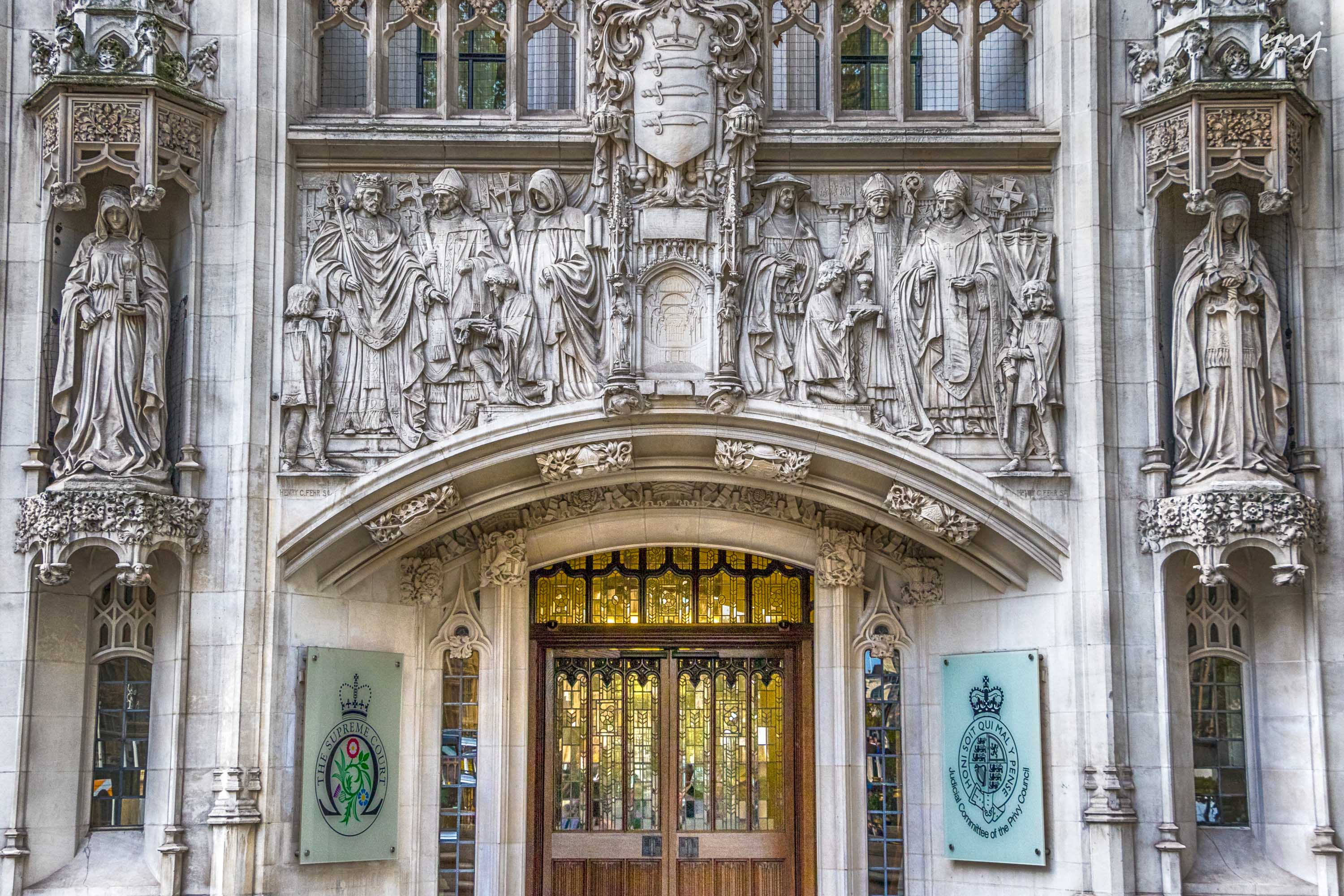
On 5 August 2024, the Supreme Court handed down its judgment in QX v Secretary of State for the Home Department, finding that Article 6 of the European Convention on Human Rights applied to the claimant’s challenge to the imposition by the Secretary of State of a temporary exclusion order made under the Counter-Terrorism and Security Act 2005.
Under that Act, the Secretary may impose such an order (a TEO) to prevent an individual from returning to the UK when certain conditions are met, including that the Secretary reasonably suspects that the individual is or has been involved in terrorism-related activity outside the UK and reasonably considers it necessary to impose a TEO to protect the UK public. The Secretary may also impose obligations on the subject of a TEO if they return to the UK, the breach of which is a criminal offence. The Act sets out a scheme for TEO subjects to apply to court to review the Secretary’s decision to impose and maintain a TEO, and/or any specific obligations that are part of the TEO.
QX, the respondent at the Supreme Court, is a British citizen who lived in Syria from 2014 to 2018. In November 2018, the Secretary imposed a TEO against him based on a belief that QX was aligned with an al-Qaeda faction. The TEO provided that if QX returned to the UK, he must regularly report to a specific police station and attend appointments with certain persons as notified to him in writing. He returned to the UK in 2019 under a permit issued by the Secretary, and became subject to those conditions.
The TEO expired in November 2020, and in early 2021 QX was convicted of three counts of breaching his reporting obligations. Before the TEO had expired, he brought an application under section 11 of the Act to review the reporting and appointments conditions, and following his conviction was permitted to amend his claim to include a challenge to the imposition and maintenance of the TEO itself. The thrust of QX’s challenge to the reporting and appointment conditions was that they violated his rights under Article 8 of the European Convention on Human Rights (the right to respect for private and family life).
The High Court litigation spawned several judgments over multiple years as the parties fought over the principles applicable to the Secretary’s disclosure. The first instance judge held that:
- QX’s challenge to the imposed conditions as violations of ECHR Article 8 involved a determination of his rights under domestic law, and so the Article 6 right to a fair trial applied.
- Accordingly, the appropriate test for the Secretary to withhold material is set out in Secretary of State for the Home Department v AF (No 3) [2009] UKHL 28 at [82]-[84]. Briefly, that case provides that where the person subject to the order is given sufficient information about the allegations to enable him to give effective instructions in relation to the allegations, there can be a fair trial even if detail or sources of the evidence forming the basis of the allegations is provided.
- A TEO qualifies a British citizen’s right of abode under the Immigration Act 1971 and falls within “the hard core of public-authority prerogatives” such that Article 6 protections did not apply to QX’s challenge to the imposition of the TEO itself. The AF (No 3) disclosure principles have no application.
With permission from the High Court, QX appealed the decision on the applicability of Article 6 to the imposition challenge. The Court of Appeal disagreed with the High Court, finding that because the challenge to the imposition of the TEO itself would be determinative of the Article 8 challenge to the conditions, QX’s civil rights were engaged and Article 6 applied to the entire proceeding, such that QX was entitled to the level of disclosure required to satisfy the right to a fair trial. The Secretary appealed to the Supreme Court.
Lord Reed wrote the Court’s judgment, joined by the six other members of the panel – Lord Lloyd-Jones, Lord Hamblen, Lord Burrows, Lord Stephens, Lady Rose, and Lady Simler. The main analysis focused on two questions:
- Is a British citizen’s right of abode a civil right within the meaning of Article 6 of the ECHR?
- Does QX’s challenge to the imposition of the TEO otherwise involve a determination of his civil rights within the meaning of Article 6 of the ECHR?
On the first question, Lord Reed considered the various judgments in the prior Supreme Court case Pomiechowski v District Court of Legnica, Poland [2012] UKSC 20. Lord Mance’s majority judgment there found that a British citizen had a common law right to enter and remain in the UK. While the Secretary argued now that any common law right was extinguished by the statutory framework in the Immigration Act 1971, the Lord Reed rejected that argument, holding that the common law right continues as modified by that statute. However, the Court agreed that the judgments of Lord Mance and Lady Hale in Pomiechowski went too far in treating the common law right as a civil right under Article 6. The concept of a civil right under that article is an autonomous concept that is not synonymous with the meaning under domestic law. The substantive nature of the right is key, and not the domestic source of the right.
Noting that a number of relevant European authorities were not cited to the Pomiechowski panel, Lord Reed referred to several extradition cases holding that legal proceedings for a state to extradite its own nationals did not engage an Article 6 civil right. Based on those cases, Lord Reed found that “it is reasonable to conclude that the European court would not regard the right of abode in the United Kingdom as a civil right within the meaning of article 6(1). … this court should therefore conclude that proceedings concerned with that right do not fall within the ambit of that article”.
The second question arose because, if QX succeeds in quashing the TEO itself, it would be decisive as to his Article 8 challenge to the conditions, as they would necessarily fall away. The Secretary argued that the first challenge was actually only potentially decisive to the second – if QX’s imposition challenge failed, the conditions would remain and QX’s challenge to them would be determined separately. But Lord Reed noted that this argument only raises the question of whether ‘potentially decisive’ is enough to trigger Article 6 protections.
Lord Reed cited various European case law and the Court’s own prior decision in R(G) v Governors of X School [2011] UKSC 30 for the principle that Article 6 protections will be engaged in a proceeding related to another concerning civil rights where a decision in that related proceeding will be truly dispositive of the civil right or capable of affecting the outcome of the proceedings in which the civil rights are to be determined. Here, the Secretary effectively conceded that if Article 6 did not apply, the evidence relied on to justify imposition of the TEO would not be available to QX on his challenge to the conditions. Lord Reed found that this logically meant that the court would not be looking at the evidence on the conditions challenge with a clean slate but on the basis of findings already made on evidence that QX did not have a fair opportunity to challenge. There is accordingly a substantial influence or effect on the determination of QX’s civil rights in the conditions challenge.
The Court dismissed the Secretary’s appeal.
Some observations:
- It was relevant here that every court accepted that the reporting and appointment conditions imposed on QX under the TEO were sufficiently intrusive to engage his Article 8 rights. The Article 6 result may have differed if the prima facie case against the TEO conditions was not as strong.
- The Pomiechowski judgments take a beating in QX, but Lord Reed goes out of his way to say that the Court is not making any decision on whether that case was wrongly decided. Nonetheless, any future reliance on Pomiechowski must take into account what the Court noted in QX about those holdings, and they are likely ripe for a challenge to overturn them explicitly. British citizens facing extradition from the UK should be wary.
- Finally, the Court emphasized the importance of the common law right to a fair trial, which does not depend on the categorization of the rights or interests at stake as civil rights or obligations under the ECHR. QX did not make any argument about the content of the domestic right, but future litigants making Article 6 points should consider whether citing the common law rights will be helpful.
At the Supreme Court, the Secretary of State for the Home Department was represented by Robin Tam KC of Temple Garden Chambers, Steven Gray of 7BR, and the Government Legal Department. QX was represented by Dan Squires KC, Darryl Hutcheon, and Rosalind Comyn, all of Matrix Chambers, and ITN Solicitors in London. The neutral citation is [2024] UKSC 26.