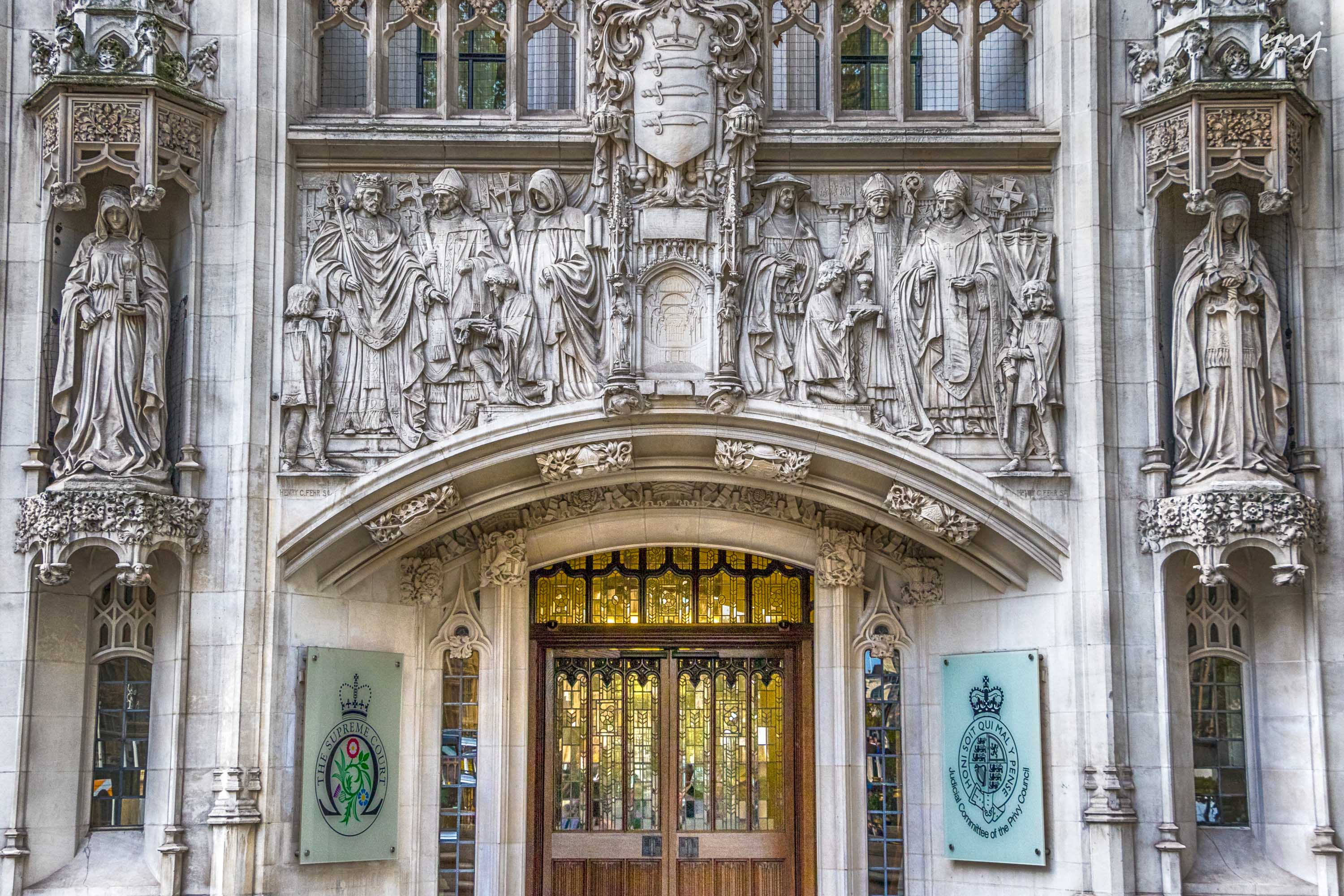
In Tesco Stores Ltd v Union of Shop, Distributive and Allied Workers & Ors, released on 12 September 2024, the Supreme Court found that Tesco could not use its contractual right to terminate employees on notice for the purpose of removing collectively bargained entitlements to permanent retained pay. The five-member panel also reinstated the High Court’s injunction against Tesco, recognizing it as an exception to ordering specific performance against an employer.
The case involved Tesco employees who had, at the employer’s request, relocated several years prior. As an inducement for that relocation, the parties agreed to a retained pay provision. The relevant term in the collective agreement, which had been incorporated into the relevant employment contracts, stated that retained pay “will remain a permanent feature” of the employee’s contract, subject only that it could be changed by mutual consent (and not collectively bargained away), would cease on promotion to a new role, or be adjusted if the employee requested a change to working patterns.
Under the employment contracts, Tesco had the usual right to terminate on notice. It wanted to end the retained pay entitlements. It offered the impacted employees two options: accept an 18-month payout of retained pay or be dismissed and re-hired on the same terms except that retained pay would be removed. Various employees refused the payout and faced the threat of being fired and rehired. The union and certain employees brought proceedings in the High Court for declaratory and injunctive relief. The High Court made the declaration and granted an injunction, finding that a term could be implied into the employment contracts preventing Tesco from terminating the contracts for the purpose of removing the retained pay rights. The Court of Appeal reversed, disagreeing with the High Court’s interpretation of the contracts, analysis on implying a term into the contracts, and the basis for granting the injunction.
At the Supreme Court, Lord Burrows and Lady Simler wrote the lead judgment, joined by Lord Lloyd-Jones. They saw the contractual tension to be between the retained pay provision’s promise of permanence and Tesco’s right to terminate on notice at any time. Tesco argued that the clauses were consistent with each other: retained pay would remain so long as the contract was in force, but like everything else was subject to Tesco’s right to terminate on notice. The Court rejected that submission, finding that it had the “alarming consequences” that Tesco could have implemented it’s hire/rehire scheme immediately after inducing the employees to relocate in return for the retained pay benefit.
In context, the majority wrote, the word ‘permanent’ in the retained pay clause must mean something different than simply co-extensive with the contract. The employees would have an obvious concern that Tesco could exercise its unfettered termination rights to undermine the permanence of the retained pay obligation. So, the real question was whether there is an implied term that qualifies Tesco’s termination right.
The Court reiterated that “to imply a term by fact, the term must be necessary for business efficacy or the term must be so obvious that it goes without saying; it must be capable of clear expression; and it must not contradict any express term of the contract”. Here, an implied qualification of Tesco’s termination right satisfied the business efficacy test as it was necessary to not undermine the promise that retained pay would be permanent.
Turning to remedy, the Court agreed with the parties that the High Court’s injunction amounted to indirect specific performance. The usual rule is that specific performance will not be ordered against an employer to compel them to continue employing a worker, but the Court cited various authorities to show that an exception exists where specific performance is otherwise just and there has been no mutual breakdown of confidence. Both factors were met in these circumstances:
- On the issue of whether the injunction was just, the majority reframed the question as whether damages would be inadequate. Because calculation of the employees’ damages would be difficult and costly, involving speculation as to how long each would otherwise remain employed at Tesco and what their prospects of mitigating loss through alternative employment would be, and because wrongful dismissal damages would not fully take into account their non-pecuniary losses, the Court considered damages to be inadequate.
- As Tesco was offering to reemploy the workers on the same terms except retained pay, there was clearly no breakdown or loss of confidence.
Accordingly, the majority agreed that the indirect specific performance was warranted. The appeal was allowed and the High Court’s injunction reinstated.
Lord Leggatt and Lord Reed each added a concurring opinion. Lord Leggatt expanded on the principles and authorities related to implying contractual terms, including a discussion on whether employer termination rights are always subject to being exercised in good faith and not arbitrarily, capriciously, irrationally, or for an improper purpose, following the Braganza v BP Shipping Ltd [2015] UKSC 17 principles. Lord Reed offered further thoughts on analysing the parties’ objective intentions in a collective bargaining context, suggesting that when a term in a collective agreement is incorporated into an employment contract, one can usually infer that the parties to the employment contract intended for the term to have the same meaning as in the collective agreement.
At the Supreme Court, the union and the employees were represented by Oliver Segal KC and Stuart Brittenden KC, both of Old Square Chambers, and Thompsons Solicitors LLP in Manchester. Tesco was represented by Anthony de Garr Robinson KC of One Essex Court, Amy Rogers KC of 11KBW, Andrew McLeod of One Essex Court, and Freshfields Bruckhaus Deringer LLP in London. The neutral citation is [2024] UKSC 28.