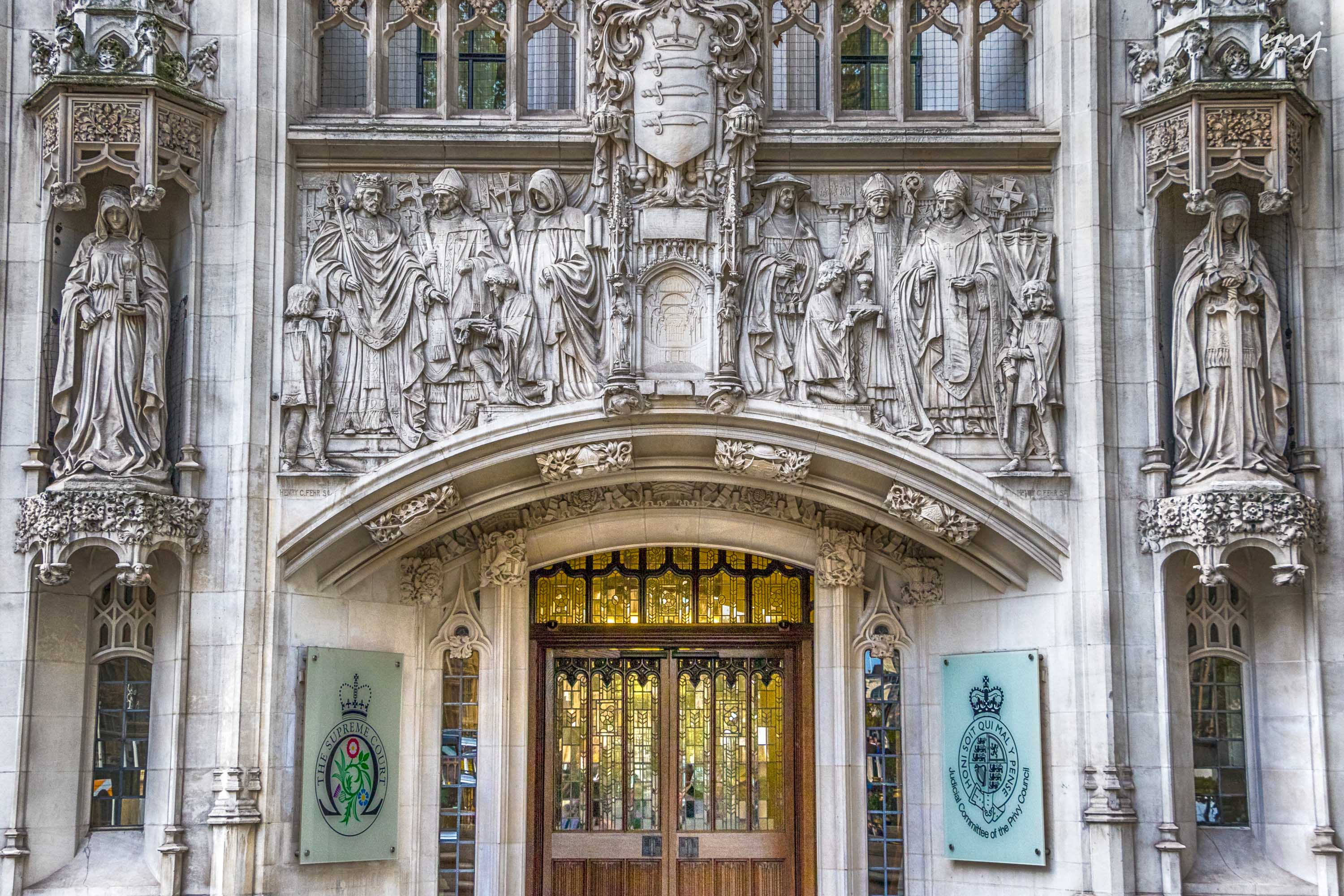
The Supreme Court released its judgment in McAleenon v Lisburn and Castlereagh City Council & Ors on 16 October 2024, finding that the Court of Appeal in Northern Ireland was wrong to conclude that the appellant had suitable alternative remedies to her claim for judicial review concerning multiple regulators’ decisions regarding a landfill site emitting odours and fumes. The case will return to the Court of Appeal for further litigation.
The appellant lived within the area of the Lisburn and Castlereagh City Council (LCCC), near the Mullaghglass Landfill. The landfill was operated by Alpha Resource Management. The appellant, and other residents in the area, had complained about odours and fumes from the landfill they said had impacted their health and wellbeing, including to the LCCC, the Northern Ireland Environmental Agency (NIEA), and the Department of Agriculture, Environment and Rural Affairs. Each of the LCCC, the NIEA, and the Department had some regulatory responsibility or supervisory authority related to the landfill site.
Unsatisfied with the regulators’ responses (or lack of responses), the appellant brought a claim for judicial review to the High Court. She claimed that the LCCC failed to properly investigate the complaints about the site, and that the NIEA and the Department failed to regulate the landfill in a manner to prevent the emissions. She also claimed that each of LCCC, NIEA, and the Department had breached her rights under Article 8 of the European Convention on Human Rights.
The public authorities argued that judicial review of their decisions was not available because the appellant had adequate alternatives remedies that she had not pursued:
- She could bring a private prosecution against Alpha for a statutory nuisance under section 70 of the Clean Neighbourhoods and Environment Act (Northern Ireland) 2011.
- She could bring a civil nuisance claim against Alpha.
- She could lodge a complaint with the Northern Ireland Public Services Ombudsman.
The High Court agreed with the appellant that no adequate alternative existed but found against her on the merits of the judicial review claim. She appealed against that finding, while the regulators cross-appealed on the alternative remedy issue. In addition, they raised a new argument on appeal that the matter was now academic, as the landfill had been closed and the ventilation wells capped.
The Court of Appeal decided to deal with the alternative remedies point as a preliminary issue and allowed the regulators’ appeal. Based on that finding, it dismissed the appellant’s appeal without reaching the merits. The appeal court said that the alternative remedies proposed would allow the appellant to achieve her real objective. The judges also expressed concern about the volume of conflicting expert witness evidence, and said that a judicial review claim was not the appropriate forum for a court to deal with factual disputes requiring cross-examination. The appellant brought the matter up to the Supreme Court.
Lord Sales and Lord Stephens wrote the judgment, with which Lord Lloyd-Jones, Lord Briggs, and Lady Simler agreed. The Court started with first principles of judicial review proceedings, noting that the focus is on an “examination of whether a public authority has acted lawfully or not” in a “speedy and effective procedure, in respect of which disputes of fact which have a bearing on the legal question to be determined … do not generally arise”. Viewed through that lens, the Court of Appeal had erred from the first delivery. It thought it had to make definitive findings of fact about the landfill odours, and was obliged to accept the regulators’ evidence in the absence of any cross-examination. But they had looked at the matter from the wrong way. The Supreme Court reinforced that the role of the court was to ask whether the regulators had done enough to justify their decisions, and to critically analyse their evidence to see whether, based on the information available to the regulators, they were made their decisions lawfully. There was no need to cross-examine witnesses or delve into significant fact finding.
The Court of Appeal’s errors on these principles coloured its assessment of the alternative remedy issue. By focusing on the complexity of resolving the disputed expert evidence in a judicial review proceeding versus an ordinary civil trial, the panel below used the wrong comparator. The appellant wants to compel the regulators to satisfy their public law duties. That relief is appropriately sought in a judicial review claim, and would not be available in private law remedies against Alpha. A private prosecution or nuisance claim were not suitable alternative remedies, Lord Sales and Lord Stephens wrote, when the question is properly framed “by reference to the type of claim the claimant has chosen to bring and what relief they have sought against the particular defendant”.
The Court marshalled other points to buttress its conclusion:
- Regulators like the ones here are supposed to act for the benefit of the public. When a member of the public tries to have the regulator comply with their duties, it is not a good answer for the regulator to tell the citizen that they should take individual action at their own expense and risk.
- The judicial review procedure is intended to be speedy and simple, and would be less complex than a full-blown trial in a private prosecution or nuisance claim against Alpha.
- Nothing in the proposed alternative remedies could address the appellant’s ECHR Article 8 complaints about the regulators’ decisions.
- There was nothing to the Ombudsman complaint remedy. The general rule is that the ability to complain to an ombudsman does not impact the right to seek judicial review. In this case, the relevant ombudsman statute expressly provides that a claim for judicial review has priority over a complaint.
Finally, the Court said that the matter is not academic due to the closure of the site, as there was no evidence that the risk of emissions was over simply because the landfill was closed and the vents were capped.
The justices allowed the appeal and remitted the matter back to the Court of Appeal to hear the challenge against the High Court’s dismissal of the judicial review claim on the merits.
The case serves as a useful reminder of the core principles around the court’s approach to judicial review and assessing whether suitable alternative remedies exist. In the environmental context, the judgment also includes a favourable citation of the Court of Appeal’s discussion in R (Richards) v Environment Agency [2022] EWCA Civ 26 on when state authorities have a positive duty under ECHR Article 8 to take steps to abate an environmental hazard which has a serious effect on the life of an individual.
At the Supreme Court, the appellant was represented by Hugh Southey KC of Matrix Chambers, Sarah Minford BL of the Bar of Northern Ireland, and Phoenix Law in Belfast. LCCC was represented by Peter Coll KC and Gordon Anthony BL, both of the Bar of Northern Ireland, and Arthur Cox in Belfast. The NIEA and the Department were represented by Tony McGleenan CBE KC and Maria Mulholland BL, both of the Bar of Northern Ireland, and the Departmental Solicitor’s Office in Belfast. The neutral citiation is [2024] UKSC 31.